













Obtenir le modèle :
Résumer cet article avec :
Companies today need more than ever to protect their cash flow.
To achieve this, one key indicator of their outstanding amount comes into play: the aging balance, also known as the accounts receivable aging report, helps finance teams track overdue invoices and optimise collections.
It’s an essential tool for making informed decisions and steering cash management effectively.
The aging balance is indispensable for teams handling customer accounting and debt collection.
(It’s also part of accounts receivable dashboard included in our software.)
It helps organise and prioritise dunning actions while monitoring performance to prevent the build-up of late payments, which, as you know, can be very costly.
In this article, we’ll take a closer look at the definition of an aging balance, how to analyse it, and above all, how to keep it young!
What is an aging balance? Definition and example
The customer aging balance is an accounting tool that summarises all your unpaid customer accounts, classified by age.
It highlights outstanding receivables, showing both their amounts and the number of overdue days.
It should not be confused with the supplier aging balance, which lists the company’s payables to its suppliers by age.
Any accounting entry (invoice or credit note) appearing in a customer account is not meant to remain open longer than the contractual payment term granted to your customer.
It’s worth tracking your aging balance both overall (for all customers) and individually (by customer).
I find this debt collection software very functional, with excellent tracking of reminders and a clear, precise dashboard. Customer service is responsive.
Stéphanie H. - Collections Officer
Discover LeanPay 👉
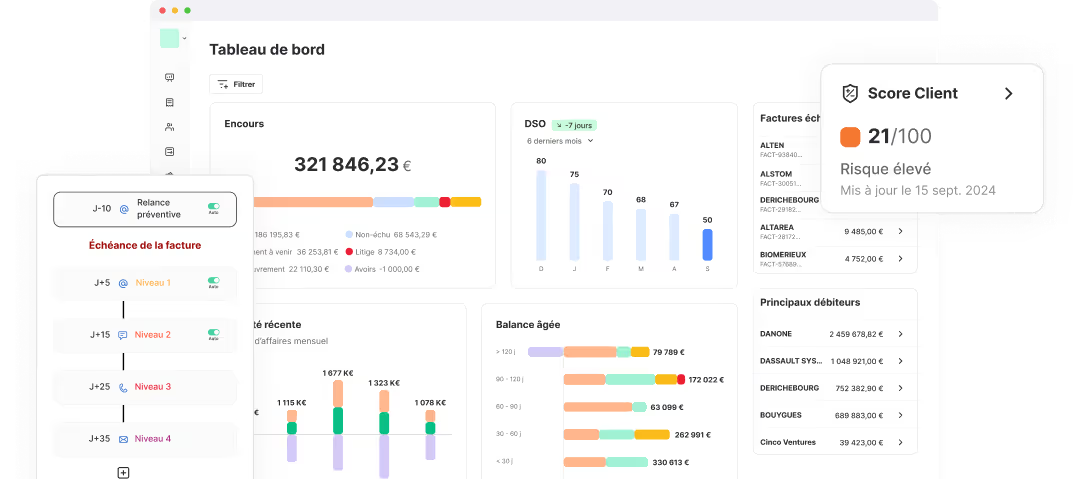
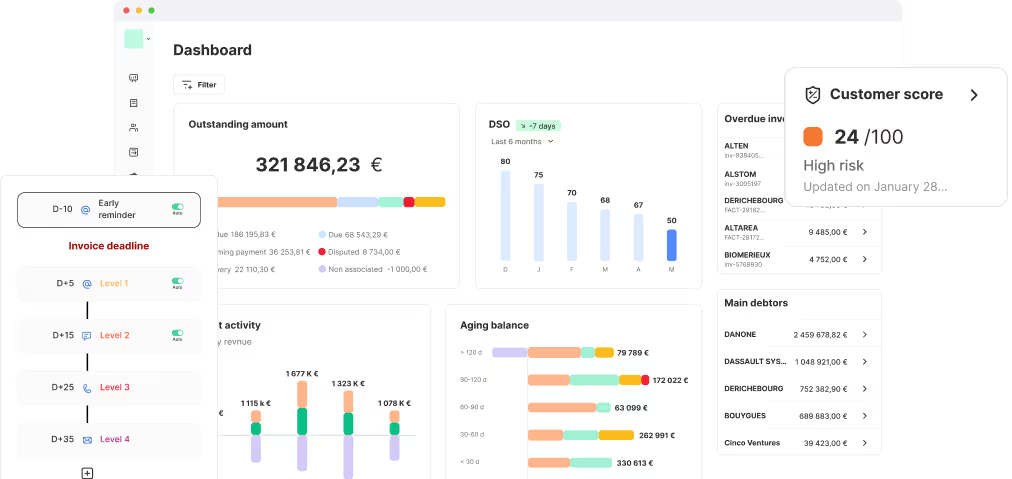
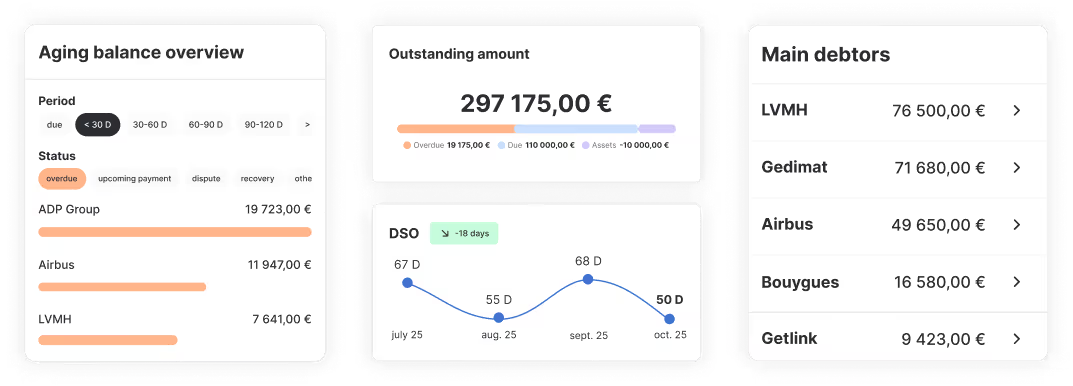
Here’s how the aging balance looks in LeanPay’s debt collection software:
.png)
- One tranche for not-yet-due receivables
- One for slight delays under 30 days
- One for delays between 30 and 60 days
- One for delays between 60 and 90 days
- One for delays between 90 and 120 days
- And finally, one for delays over 120 days (4 months)
The advantage of calculating and tracking your aging balance through our software is that it’s updated in real time thanks to automatic data imports.
It’s also interactive: by clicking on a specific segment, you can instantly see which customers are late and for what amounts.
.png)
And that’s not the only KPI updated live in our dashboard.
LeanPay also provides your overall and per-customer DSO, your outstanding amount, monthly activity reports, and cash flow forecasts based on your customers’ actual payment behaviour.
If you’re interested, we can call you back to show you the tool in detail.
Why the aging balance matters for your collections strategy
Segmenting receivables by age allows you to perform both a quantitative analysis (outstanding amount) and a qualitative analysis (payment behaviour).
It highlights late-payment rates and lets you break them down by delay category.
Another useful approach is the billing cohort method, grouping invoices by issue month (for instance, all invoices issued in November) and showing the collection rate over time until it reaches 100%.
Both tools are complementary for accurate analysis.
In the aging balance, this hierarchy of receivables by descending delay is ideal for defining dunning priorities and reducing late payments.
Tracking your aging balance helps you:
- Monitor cash flow and working capital requirement (WCR)
- Fine-tune your collections strategy by quickly identifying high-risk customers, largest receivables and oldest debts
- Track payments systematically: who has paid and who still owes money
- Evaluate collection performance through the late-payment rate
- Reassess your payment policy if recurring patterns appear. For instance, several customers showing the same behaviour may reveal a lack of clarity in your commercial terms.
How to analyse your aging balance and improve payment delays
Reading your aging balance and acting on it are both vital steps in your collections policy.
As every credit manager knows, the older a receivable gets, the less likely it is to be paid.
At the invoice due date, the probability of payment is 100 %.
After 30 days of delay, it drops to 75 %.
At 90 days, it’s down to 50 %.
After 8 months, only 10 % of receivables are still paid.
You get the idea :-)
Step 1: Establish priorities
If it’s your first time calculating the aging balance, start with a clear picture that helps you prioritise your dunning actions in two ways:
- Target the oldest receivables first, then the more recent ones. Some may need to be written off: a difficult but necessary step to focus on recoverable amounts.
- Target the largest receivables to recover as much cash as possible.
This method will help you “rejuvenate” your aging balance.
Be rigorous and methodical: one common mistake is to ignore “non-priority” customers who end up never being chased.
Every customer with overdue invoices must be reminded.
Step 2: Implement a long-term strategy
The goal is to maintain as few unpaid and aged receivables as possible.
When late payments occur (and they still do far too often) ensure the delay remains as short as possible.
Even a small DSO reduction has a strong impact on your cash flow.
To achieve this, setting up automated dunning scenarios is an effective approach.
As soon as a payment delay is detected, an email reminder is sent automatically. You define your own dunning plans based on frequency and customer types.
Your customers will pay faster and gradually get used to paying on time, because they know they’ll ALWAYS be reminded. No receivable will be forgotten.
97,5 % of invoices are paid during this internal dunning phase. That’s the average observed among LeanPay users.
Here’s a practical example of how to apply it:
- For the not-yet-due segment: send a pre-due reminder 5 days before due date.
- For delays under 30 days: plan level 1 and level 2 reminders.
- For delays between 30 and 60 days: start mentioning late-payment penalties (levels 3 and 4).
- For delays between 60 and 120 days: use level 5 reminders, ideally by registered letter. This stage marks the end of amicable recovery and the beginning of legal action.
- For delays over 90 days: those receivables should likely be provisioned as doubtful or written off.
Your objective: keep the oldest categories of your aging balance as “empty” as possible and sustainably so.
Evaluate your collections performance
Monitoring your aging balance also lets you assess whether your collections strategy is effective.
Beforehand, define target thresholds for maximum acceptable late-payment rates per segment.
A high late-payment rate isn’t necessarily “serious” if the receivables are only slightly overdue.
However, it becomes more concerning if the global rate looks good but mainly hides very old unpaid invoices.
The goal is clear: maintain the lowest possible late-payment rate across your outstanding amount, and ensure it drops progressively as receivables age. This is how you rejuvenate your aging balance.
Here’s an example to illustrate:
.png)
This aging balance shows an overall late-payment rate of around 21,79 %, which is rather high.
It also reveals a recurring problem with Company B, which accumulates delays (46,34 % for 3 800 €).
Worse still, over a quarter of these receivables are more than 90 days overdue.
Company B has barely paid for months.
In this case, it’s urgent to take the necessary action.
Obtenir le modèle :
Obtenir le modèle :