













Obtenir le modèle :
Résumer cet article avec :
Businesses, especially SMEs and mid-sized companies, face a constant challenge: protecting cash flow while reducing late payments.
This is where AI debt collection is changing the game.
Modern AI-powered debt collection software can now analyse payment behaviour, predict late payments and personalise payment reminders automatically. The objective is not simply to automate collections workflows, but to help finance teams prioritise actions, improve payment forecasting and recover invoices faster.
Basic automation is already standard in most collections platforms. LeanPay has been offering automated reminder workflows for years already 😀
What is changing now is the ability to make collections smarter, more predictive and more adaptive.
Far from being just another technology trend, AI is reshaping how businesses manage outstanding invoices and customer risk. In this article, we explore the practical benefits of AI debt collection, the regulatory implications of AI adoption and the challenges businesses need to anticipate.
Important: AI cannot handle debt collection entirely on its own. It is a support tool designed to help operational teams make better decisions and work more efficiently. Human expertise remains essential, especially for sensitive or complex situations. AI simply helps teams improve results through faster payments, better customer relationships and stronger risk management.
I find this debt collection software very functional, with excellent tracking of reminders and a clear, precise dashboard. Customer service is responsive.
Stéphanie H. - Collections Officer
Discover LeanPay 👉
Machine learning and NLP: what do they actually mean?
Thanks to machine learning, predictive algorithms and natural language processing (NLP), AI-powered debt collection software is becoming a genuine operational assistant capable of optimising every stage of the collections process.
Before going further, let’s look at these two core technologies in more detail.
Machine learning
Machine learning allows debt collection software to continuously learn from historical and real-time data.
By analysing thousands of interactions between businesses and customers, algorithms can:
- identify payment behaviour patterns;
- detect early warning signs of late payment;
- adapt reminder strategies based on previous outcomes.
Natural language processing (NLP)
Natural language processing plays a major role in automating customer communications.
This technology enables AI to:
- understand and analyse emails, letters and messages;
- identify customer intentions such as payment promises, disputes or extension requests;
- generate more relevant responses automatically.
NLP can also adjust the tone of payment reminders depending on the customer profile:
- a firmer approach for bad payers;
- a more diplomatic tone for customers facing temporary difficulties.
Thanks to these technologies, AI debt collection software can dynamically adapt to customer behaviour, personalise interactions and automate the actions most likely to recover outstanding amounts faster.
Benefits of AI debt collection software
Artificial intelligence helps businesses make more informed decisions and adopt a more proactive approach to accounts receivable management.
That said, integrating AI into debt collection also comes with challenges. Before looking at the benefits, it is important to understand the key risks businesses must manage.
Preserving customer relationships
Automation should never make debt collection feel impersonal.
An overly robotic approach could damage customer loyalty and negatively affect the customer experience. Businesses therefore need to strike the right balance between AI and human intervention, especially for sensitive cases requiring a personalised approach.
Ensuring data quality
AI models rely on accurate and up-to-date data.
If the underlying information is incomplete or unreliable, predictive analysis becomes less effective. High-quality financial and operational data is therefore essential.
Protecting sensitive data
AI processes large volumes of sensitive information, particularly accounting and financial data.
Businesses must therefore guarantee:
- data confidentiality;
- GDPR compliance;
- strong cybersecurity standards.
With these challenges in mind, let’s explore the benefits of integrating AI into debt collection software.
AI fundamentally improves traditional collections methods such as automated reminder workflows by introducing better forecasting, smarter automation and more advanced personalisation.
Predictive analytics and payment forecasting
Using machine learning algorithms, AI can analyse large volumes of data to detect weak signals that indicate future late payments.
This includes:
- previous payment behaviour;
- increasingly frequent or longer payment delays;
- economic conditions affecting a specific sector;
- payment trends observed across similar companies;
- financial information from external databases such as Creditsafe, Altares or Ellisphere.
However, AI debt collection does not only analyse how a customer behaves with your business.
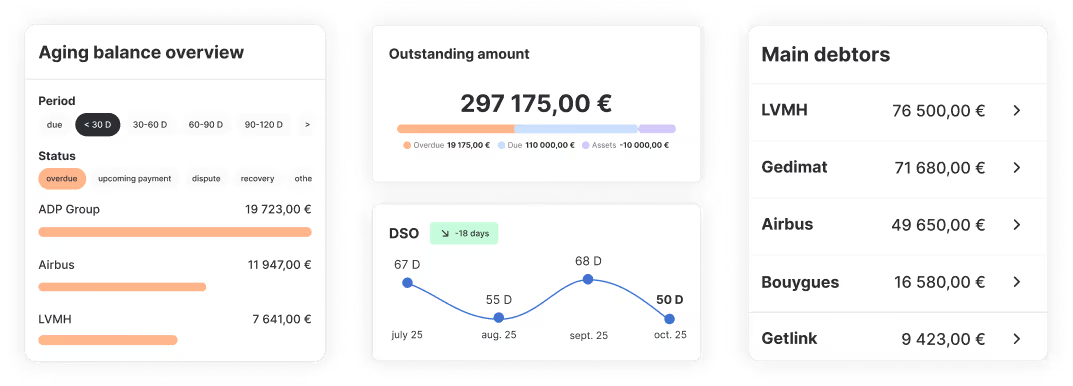
It can also analyse payment behaviour across multiple suppliers using the same debt collection software, creating a much broader and more reliable view of customer risk based on data from hundreds of thousands of companies.
This enables AI to produce more accurate and relevant risk scoring.
AI can also quickly identify anomalies within customer accounts that may lead to payment delays.
Using these analyses, AI can estimate:
- the probability of an invoice being paid on time;
- the likelihood of late payment;
- the expected payment date.
This creates two major benefits:
✅ Preventive action recommendations: adjusting payment terms, reducing outstanding amount limits or applying more targeted reminder strategies.
✅ Improved cash flow forecasting: more accurate payment projections and stronger cash flow management.

Smarter prioritisation of payment reminders
Traditionally, payment reminders follow fixed rules. For example, a first reminder email after 5 days overdue, a second reminder after 15 days and escalation after a defined period.
With AI, this approach becomes far more dynamic and efficient.
Artificial intelligence can prioritise accounts according to their risk level and automatically adapt the reminder workflow.
For example:
- Low-risk customers: a polite reminder email may be enough.
- Medium-risk customers: closer follow-up and phone calls may be recommended.
- High-risk customers: rapid and personalised intervention becomes necessary, with firmer communication or earlier legal action.
AI can even recommend when a collections specialist should take over particularly sensitive or complex cases.
The objective is simple: focus collections efforts where they are most effective and help teams prioritise the most critical accounts.
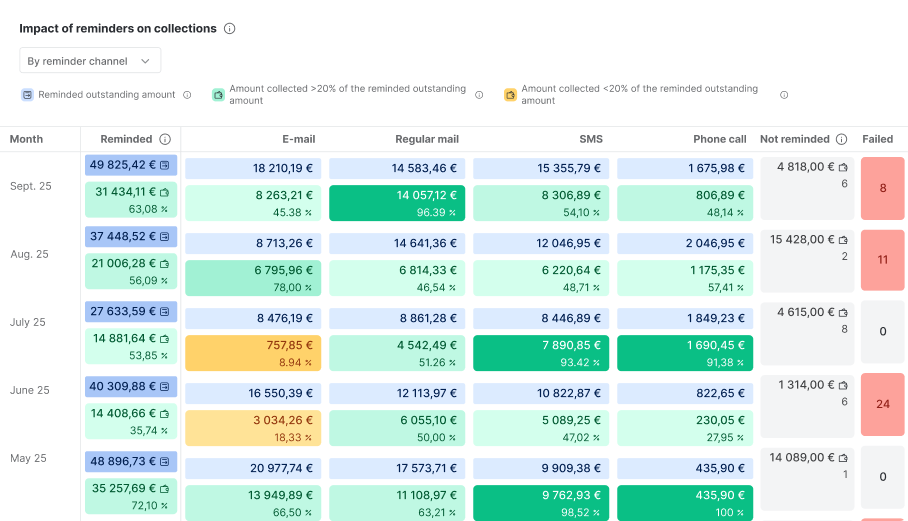
With LeanPay, you can analyse the impact of your payment reminders on collections performance through dashboards showing:
- sender performance;
- days overdue;
- reminder levels;
- communication channels;
- reminder workflows.
This helps businesses identify which reminder strategies generate the best results.
Personalised payment reminders and intelligent automation
Traditional reminder systems usually apply the same logic to every customer.
AI changes this completely by enabling highly personalised collections strategies based on:
- customer profile;
- communication preferences;
- payment habits;
- previous interactions.
Artificial intelligence analyses customer responses and behaviour to identify the most effective collections strategy.
To maximise recovery rates, AI can adjust in real time:
- The tone of the message: A customer who regularly pays late but remains reliable may receive a softer reminder than a customer showing signs of financial distress. AI can also automatically translate reminder communications into the customer’s preferred language.
- The communication channel: Some customers respond better to emails, while others require phone calls to trigger payment.
- The timing of reminders: AI can determine the best time to send reminders based on customer reading and response habits.
This level of personalisation improves response rates and increases the chances of recovering invoices quickly without damaging customer relationships.
LeanPay allows businesses to create fully customisable reminder workflows based on their own criteria.
You can define:
- communication channels;
- sending frequency;
- number of reminder steps;
- message tone.
In addition, automation rules help prioritise sensitive accounts by automatically reassigning customers to dedicated reminder workflows when their situation changes.
.png)
For example, if a customer’s average payment delay exceeds 60 days, LeanPay can automatically assign them to a “high-risk customer” reminder workflow.
The EU AI Act: a new regulatory framework
While artificial intelligence creates significant opportunities, it also introduces new regulatory challenges.
In March 2024, the European Union adopted the EU AI Act, a regulation designed to govern the use of artificial intelligence technologies.
This legislation introduces different obligations depending on the risk level of AI systems and includes substantial penalties for non-compliance, reaching up to 35 M€ or 7 % of global annual turnover for the most serious breaches.
The main implementation milestones currently expected are:
- 2025: ban on AI systems considered to present unacceptable risk.
- 2026: mandatory compliance requirements for high-risk AI systems.
- 2027: full implementation of the regulation for affected businesses.
The four AI risk levels defined by the EU AI Act:
- Unacceptable risk: Complete prohibition of AI systems considered dangerous for fundamental rights, such as real-time biometric surveillance or behavioural manipulation.
- High risk: Strict obligations for AI systems used in sensitive sectors including healthcare, education, employment and justice.
- Limited risk: Transparency obligations for systems such as chatbots or AI image generation tools.
- Minimal risk: No specific restrictions for common AI systems without critical impact, such as spam filters or voice assistants.
These regulations will directly affect AI debt collection software providers.
Software vendors will need to ensure that their algorithms comply with these requirements while integrating appropriate monitoring, transparency and explainability mechanisms.
FAQ about AI debt collection
How does AI improve debt collection?
AI improves debt collection by analysing payment behaviour, identifying high-risk accounts and helping teams prioritise the most effective actions. AI-powered collections software can also automate payment reminders, personalise communication and improve cash flow forecasting.
Can AI predict late payments?
Yes. Machine learning algorithms can analyse historical payment data, customer behaviour and external financial information to identify early warning signs of late payment. This helps businesses take preventive action before invoices become overdue.
Is AI debt collection compliant with GDPR?
AI debt collection software can be GDPR compliant if businesses apply appropriate data protection, transparency and security measures. Companies using AI must also ensure compliance with regulations such as the EU AI Act.
Will AI replace collections teams?
No. AI is designed to support collections teams, not replace them. Human intervention remains essential for sensitive cases, negotiations and customer relationships. AI mainly helps teams work more efficiently and make faster decisions.
What are the benefits of AI-powered collections software?
The main benefits include:
- faster invoice recovery;
- improved cash flow forecasting;
- more personalised payment reminders;
- smarter prioritisation of accounts;
- reduced manual workload for collections teams;
- better customer relationships.
Obtenir le modèle :
Obtenir le modèle :