













Obtenir le modèle :
Résumer cet article avec :
Maintaining a strong relationship with your customers is vital for every business. Customer satisfaction directly impacts your credibility and reputation.
Formalising your mutual commercial commitments helps anticipate many potential issues. Yet, unexpected situations can always arise: human error, defective products, supply chain issues, or external factors.
And when there’s a dispute, there’s often a payment delay. A customer who contests an invoice will not pay it until their concern is resolved. Effective dispute management therefore has a direct impact on payment delays and, by extension, on cash flow.
In credit management, everything is designed to accelerate cash collection and nurture a true cash culture across the company. That’s why implementing a clear dispute management process is essential.
This article gives you the keys to anticipating, handling, and resolving disputed invoices efficiently, so they have minimal impact on your DSO.
What is a disputed invoice?
Types of disputes
It is important to categorise disputes, as the people responsible for resolving them vary, and so do the methods. A clear classification supports faster and more effective resolution.
Here are common dispute categories:
- Quality dispute: defect or poor-quality service or product.
- Price dispute: difference between the invoiced amount and the agreed price (e.g. free delivery charged on the invoice).
- Transport dispute: damage caused during shipping.
- Delivery delay dispute: promised deadlines not met.
- Missing items: discrepancy between what was invoiced and what was delivered.
- Duplicate invoice: the same service or product invoiced twice by mistake.
You can, of course, create your own categories based on your sector and internal challenges.
LeanPay’s accounts receivable software makes dispute management easy. You can create unlimited custom categories to track and monitor each dispute efficiently.
.png)
Some disputes involve your company directly. Others may concern subcontractors. Regardless, you remain responsible for managing them. Your customer should never be told to “deal with someone else”.
Disputed invoices and payment delays
A recoverable receivable must be liquid (the amount is clearly stated), due (the invoice is past its payment date), and certain (the invoice cannot be contested). When a dispute arises, the receivable becomes uncertain.
As long as the dispute remains unresolved, you cannot recover the payment. Disputed invoices often cause significant payment delays, leading to cash flow tension, higher working capital requirements, and customer dissatisfaction.
I find this debt collection software very functional, with excellent tracking of reminders and a clear, precise dashboard. Customer service is responsive.
Stéphanie H. - Collections Officer
Discover LeanPay 👉
How to manage customer disputes effectively
Track disputes properly
A structured process is essential for efficient dispute management. Ask yourself:
- Is there a dedicated dispute manager, or does each sales rep handle their own customer disputes?
- Who is responsible for resolving disputes, and what is their scope of action?
- How are updates shared between departments (production, logistics, R&D, etc.)?
- How is information transferred to the finance team once the dispute is resolved?
- Is all dispute information centralised in one place?
By defining these steps clearly, you’ll ensure faster dispute resolution. A well-managed dispute can even strengthen the customer relationship, whereas poor handling will inevitably damage it.
How to react to a customer dispute
When a customer contests an invoice, it’s easy to react emotionally. Instead, follow these best practices:
- Act quickly: Respond without delay and acknowledge the complaint. Show your customer that their concern has been heard and that your company is already working to resolve it.
- Review the contract: It defines the commercial relationship and protects both parties. Many disputes can be resolved by referring to the agreed terms and conditions.
- Stay calm: Losing your temper only escalates the situation. Professional composure helps maintain constructive dialogue.
- Communicate openly: Keep your customer informed of the progress. Some disputes require investigation with suppliers or subcontractors, so be transparent about each step. Listening and empathy often ease frustration.
- Offer a solution: Compensate for the inconvenience, for instance, a discount, a credit note, or a replacement. If your responsibility is clear, offer a goodwill gesture before the customer requests one. It will be perceived more positively.
- Improve your processes: A dispute can highlight weaknesses in internal workflows. Use it as an opportunity to strengthen procedures and prevent similar cases in the future.
Dispute management in collections
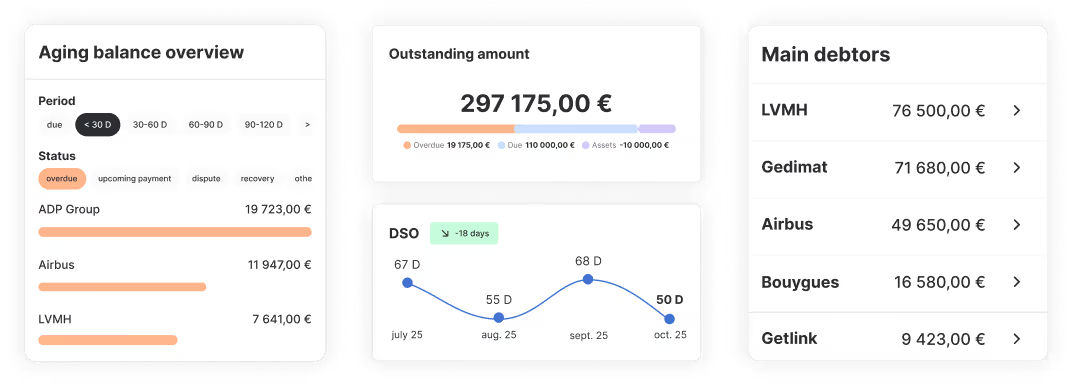
Because they impact payment timing, customer disputes are closely linked to the collections process. In credit management, the goal is to get paid as close to the due date as possible. A disputed invoice almost always delays payment, increasing your DSO and straining cash flow.
That’s why dispute management must be an integral part of your accounts receivable strategy.
The importance of pre-due date reminders
The faster you detect a dispute, the faster you can solve it, and get paid on time. Discovering a dispute 10 days after the due date is already too late.
We recommend sending a pre-due date reminder about 5 to 7 days before the invoice due date. It should include the amount and payment date. This reminder can easily be automated using LeanPay’s accounts receivable software.
A pre-due payment reminder helps confirm that everything is in order and flags any dispute before it causes a delay. Once identified, the goal is to resolve it swiftly so the payment can still be made on time. This reduces the risk of late payments and helps optimise your DSO.
Dispute management with LeanPay
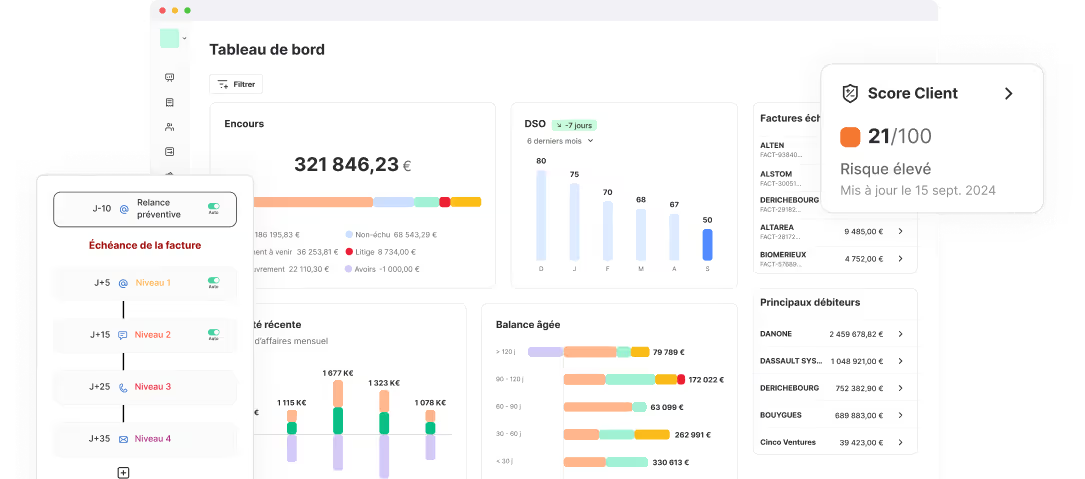
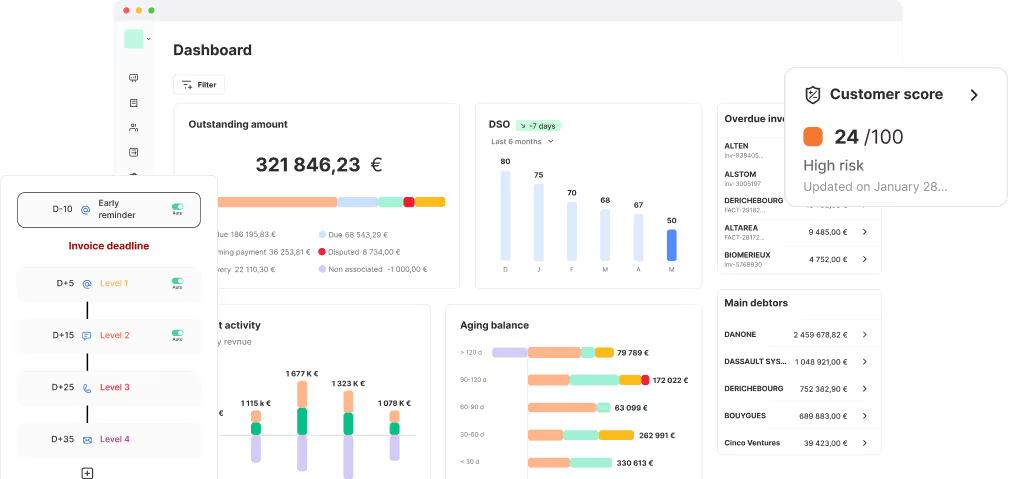
In LeanPay, dispute management is designed to simplify your workflow. You can categorise disputes based on your internal labels, such as price, product or delivery delay.
When you mark an invoice as disputed, it automatically pauses the payment reminder sequence. Of course, it would not make sense to send reminders for a disputed invoice. The relationship is already sensitive, and reminders could make it worse. However, the invoice still counts towards your outstanding amount for visibility and reporting.
You can also build reminder workflows that include pre-due date notifications. Automating these reminders saves hours of manual effort.
.png)
Since LeanPay is collaborative, your sales teams can contribute to the dispute resolution process, leaving comments and tagging colleagues. Once resolved, the finance team is instantly notified so the invoice status is updated.
If you’d like to learn more about dispute management in LeanPay, book a call with one of our experts.
Late payment penalties and disputed invoices
Never apply late payment penalties to a disputed invoice based on its original due date. As long as the invoice is in dispute, it’s not legally payable.
Once the dispute is resolved, you can consider the new due date as the settlement reference point. From there, late payment interest can be calculated, since the receivable is once again liquid, due and certain.
Obtenir le modèle :
Obtenir le modèle :