













Obtenir le modèle :
Résumer cet article avec :
Using a cash discount to bridge cash flow gaps is a simple and cost-effective way for businesses to reduce the risk of late payments. Payment delays have been rising steadily, and the cash flow pressure they create is now one of the leading causes of business failure.
An early payment discount is one of the credit management solutions available to address this risk.
This article covers everything you need to know: the different types of early payment discount, their benefits and how to calculate the cost of a discount for your business.
I find this debt collection software very functional, with excellent tracking of reminders and a clear, precise dashboard. Customer service is responsive.
Stéphanie H. - Collections Officer
Discover LeanPay 👉
What is an early payment discount?
In accounting, two types of discount operations are commonly distinguished: invoice discounting and the early payment discount. Both serve the same underlying purpose: enabling a business to receive payment quickly and avoid cash flow shortfalls.
Here is how to tell them apart.
Invoice discounting
Invoice discounting is a short-term financing solution. It allows a business to transfer a bill of exchange (such as a trade bill, promissory note or other payment instrument) up to the value of the receivable arising from a transaction with a customer. Following this transfer, the bank advances payment of the receivable before the due date, deducting its fees in the process.
Early payment discount
Another approach is to offer your customer an early payment discount. This involves giving the customer the opportunity to pay their invoice before the due date in exchange for a reduction on the amount owed.
This arrangement is advantageous for your customer, but also for you. It is an effective way to reduce your DSO by receiving payment ahead of the agreed due date.
It also strengthens the customer relationship by offering a discount rather than having to impose late payment penalties. And it sends a positive signal about your business if you are looking to build a long-term commercial relationship.
How to calculate a cash discount
Calculating invoice discounting
Invoice discounting is subject to bank charges. The amount varies depending on the discount rate applied by the bank, and the resulting fees are calculated pro rata based on the number of days between the financing date and the invoice due date.
In practice, the fees are calculated using the following formula:
Discount fees = (invoice value x discount rate x number of days) / 36.000
Let us take an example to illustrate this.
Company A sells 10.000 € of goods to Company B and sets a payment term of 45 days.
Although Company A has delivered the goods, it will not receive payment for 45 days. If Company A is currently facing financial difficulties, it can ask a bank to discount this receivable.
Now, let us assume the bank applies a discount rate of 8%. The payment term on the invoice is 45 days. If the discount is activated on the same day the invoice is issued, the number of days to use in the calculation is 45. Otherwise, it corresponds to the period between the discounting date and the receivable due date. Here, the value of the bill of exchange transferred to the bank equals the invoice amount: 10.000 €.
Applying these values to the formula above:
Discount fees = (10.000 x 8 x 45) / 36.000 = 100 €
The amount advanced by the bank will therefore be:
Amount received = 10.000 - 100 = 9.900 €
The bank finances Company A's receivable at 9.900 € out of the original 10.000 € invoice. The 100 € difference represents the bank's management and discounting fees.
Calculating an early payment discount
When you offer an early payment discount, you are free to choose both the discount rate and the timeframe during which it can be taken. If your customer pays within the period you have defined, they receive the agreed reduction.
Your invoice must include all mandatory information and be beyond dispute, as must the goods or services provided. Everything must be in order to avoid the invoice becoming disputed. If it is, your customer will not pay until the dispute has been resolved, regardless of any discount on offer.
Here is an example:
You invoice your customer 3.000 € and offer a 6% early payment discount if payment is made within 10 days of the invoice date. Under standard terms, this would be expressed as "6/10, net [your payment terms]". If they pay within that window, they settle for 2.820 €.
Improve your cash flow with an early payment discount
Whether commercial or bank-based, a cash discount is a particularly attractive payment option for businesses facing temporary cash flow difficulties or looking to finance their suppliers more efficiently. Getting paid quickly reduces the average payment time and improves working capital.
Rather than going through a potentially lengthy collections process with no guarantee of recovery, an early payment discount allows you to avoid that situation altogether. If you do find yourself in that position, here are three practical steps to improve your collections:
- Chase early: do not wait when you notice an unpaid invoice. The sooner you follow up, the better your chances of getting paid quickly. A pre-due date reminder is one of the most effective ways to anticipate the risk of non-payment.
- Automate your collections: unpaid invoices cost your business money. Avoid losing more by spending hours chasing manually. Set up reminder workflows for different scenarios and automate their sending to free up your team's time.
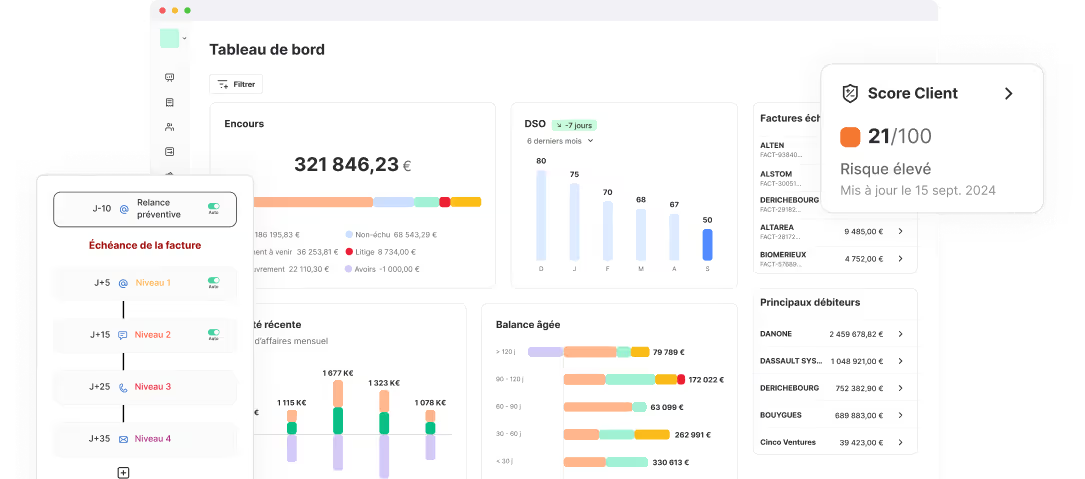
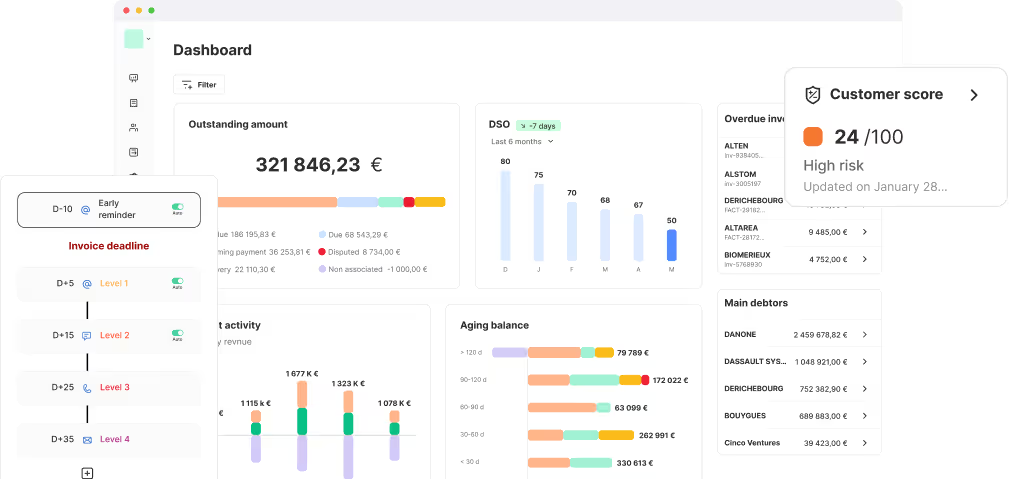
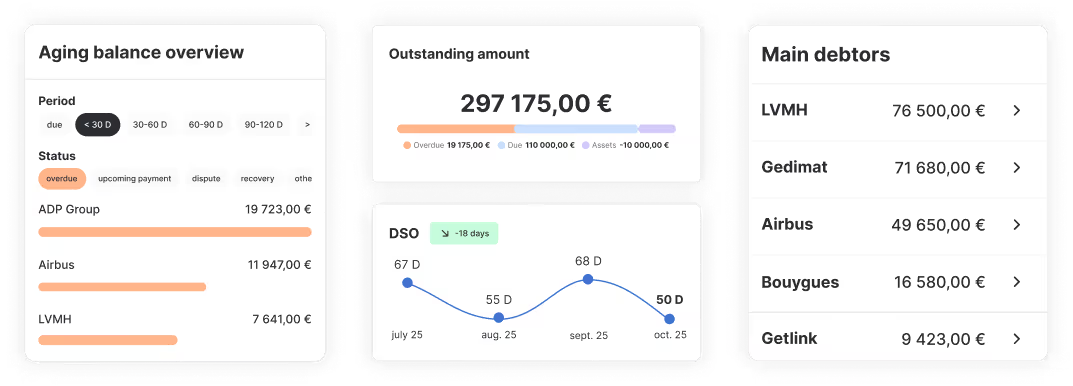
- Use an accounts receivable software: solutions like LeanPay help you reduce your DSO and avoid unpaid invoices. With a real-time view of your accounts receivable dashboard, it becomes easy to identify bad payers and customers who require closer attention.
Obtenir le modèle :
Obtenir le modèle :