














Obtenir le modèle :
Résumer cet article avec :
Working capital is one of the most closely watched indicators in financial management, yet it is often misunderstood or tracked too late.
What exactly is the working capital requirement? Why does it matter? How do you calculate it? How can you improve it? And what is the difference between working capital and the normative working capital requirement? This article covers everything you need to know.
Working capital: definition
Working capital, or working capital requirement, is a fundamental indicator in financial management. It is used to assess the financial balance of a business at any given point in time. Specifically, it measures a business's cash requirement arising from timing differences between:
- collection delays: the gap between the invoice date and the actual payment date from customers
- payment delays: the gap between the purchase date and the actual payment date to suppliers
- inventory turnover time
I find this debt collection software very functional, with excellent tracking of reminders and a clear, precise dashboard. Customer service is responsive.
Stéphanie H. - Collections Officer
Discover LeanPay 👉Why track your working capital requirement?
By measuring a business's financing needs against revenue forecasts, working capital is a highly relevant accounts receivable indicator.
Beyond the headline figure, it is important to analyse its main components, which vary depending on the business, its sector and its organisation.
The goal is to prioritise actions on the most significant items. For example, you might focus on reducing payment delays or streamlining the procurement process.
Working capital formula and calculation
The working capital calculation is performed using the end-of-year balance sheet, based on the following formula:
Inventories + trade receivables + other receivables - trade payables - tax and social liabilities = working capital requirement
The result will be either:
- a positive working capital requirement: the business has a cash funding need. Outflows are faster than inflows, meaning the payment terms granted to customers are longer than those the business must meet with its own suppliers.
- a negative working capital requirement: this represents an operating funding resource that optimises the business's cash position, meaning inflows are faster than outflows.
One limitation of the working capital figure is that it masks seasonal effects. It is not representative of the business's average activity, as it reflects a snapshot at a specific point in time: the year-end close.
Ideally, the working capital requirement should therefore be calculated independently of the balance sheet.
Normative working capital requirement: definition
This is where the normative working capital requirement comes in, a more analytical method developed by chartered accountants.
It measures the impact of changes in each working capital component on cash funding needs. To do this, two parameters must first be defined for each item:
- the turnover time
- the structure coefficient, also known as the weighting coefficient
Turnover time in the working capital requirement
Each working capital requirement item is measured in average number of days:
- the average customer invoice payment time
- the inventory turnover time
- the average supplier invoice payment time
Structure coefficient: how it shapes your working capital
The structure coefficient measures the importance of each working capital component relative to annual revenue excluding VAT. For example:
- Structure coefficient for inventories = annual item flow excluding VAT / annual revenue excluding VAT
- Structure coefficient for trade receivables and payables = annual item flow including VAT / annual revenue excluding VAT
Normative working capital calculation: step-by-step example
Let us take the example of Company X, with the following data:
- Annual revenue excluding VAT: 11 M€
- Customer credit terms: 60 days
- Raw material purchases: 3 M€, with a storage time of 35 days and supplier payment terms of 55 days
- Other purchases: 2 M€, with average supplier payment terms of 30 days
You can set up a table listing the different working capital requirement items and their respective turnover times, as shown below:
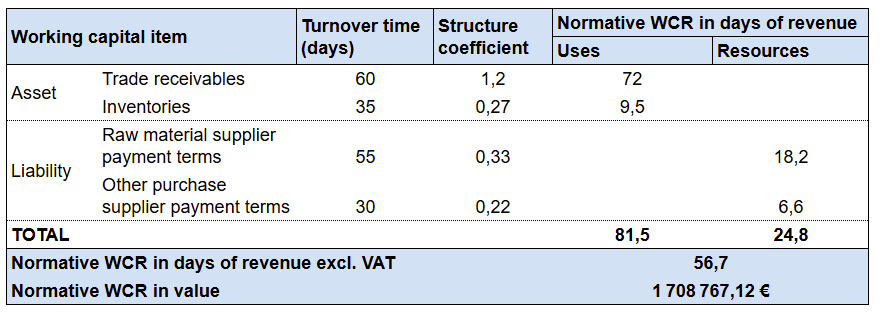
To calculate the weighting coefficients:
- Structure coefficient for trade receivables: 11 x 1,20 (VAT) / 11 = 1,2
- Structure coefficient for inventories: 3 / 11 = 0,27
- Structure coefficient for raw material purchases: 3 x 1,20 / 11 = 0,33
- Structure coefficient for other purchases: 2 x 1,20 / 11 = 0,22
Note that the VAT amount may vary depending on output VAT and input VAT. Where two different rates apply, output VAT must be included in the calculation of the trade receivables coefficient.
Each turnover time in days is then multiplied by the weighting coefficient. This produces a result for each working capital component:
- a use, if it is an asset item
- a resource, if it is a liability item
The normative working capital requirement in days is the difference between total uses and total resources. In our example, the result is 56,7 days (81,5 - 24,8).
The normative working capital requirement in value is calculated by multiplying the normative working capital in days by revenue and dividing by 365. For Company X: 56,7 x 11 / 365 = 1 708 K€.
How to improve your working capital requirement
Data is the foundation of better accounts receivable management. Now that the normative working capital has been calculated, the next step is to analyse it and draw conclusions.
If the results fall short of your targets, several levers are available:
- Reduce your DSO
- Extend your supplier payment terms
- Accelerate inventory turnover
Reduce your DSO and improve your working capital requirement
Our debt collection software helps you reducing DSO with a direct impact on your working capital requirement. Designed for SMEs and mid-sized businesses, the platform offers features that allow you to:
- Personalise your payment reminders by choosing the most appropriate channel for each customer (SMS, email, phone, letter).
- Accelerate cash collection through automated bulk sending of reminders and an online payment platform, easily accessible from email and SMS reminders.
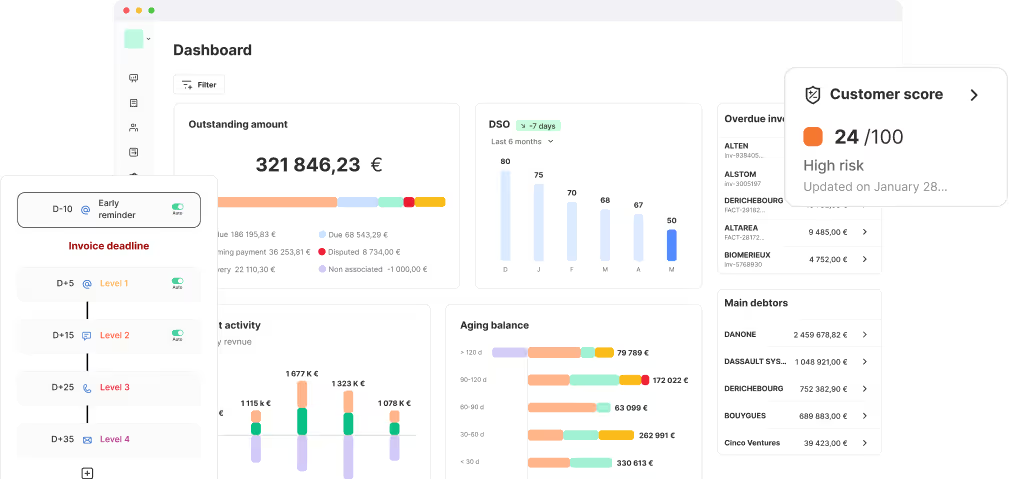
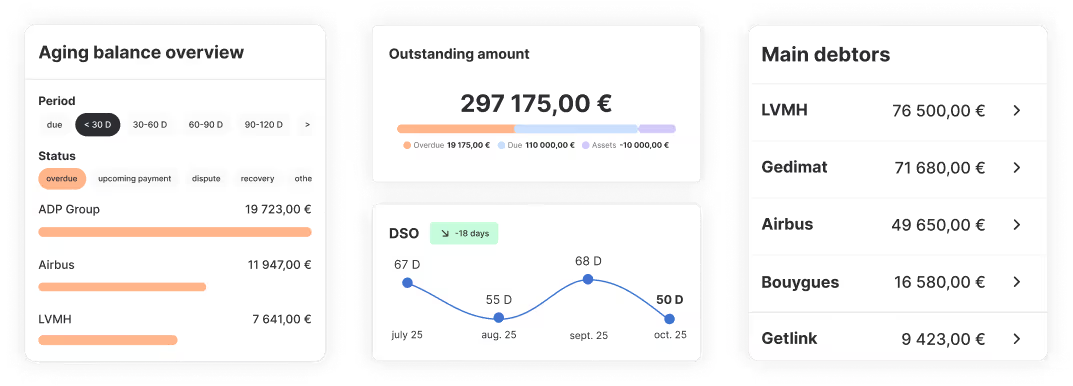
- Make informed decisions through accounts receivable reporting, which displays key indicators such as aging balance and DSO, updated in real time.
- Protect against bad debt risk through credit scoring and authorised credit limits, automatically synchronised via our integrations with leading financial information providers (Altares, Ellisphere, Creditsafe, Infolegale).
If you would like to find out more about LeanPay, get in touch and we will call you back.
Extend your supplier payment terms
The objective is to buy more time by negotiating with your suppliers to extend payment terms, so that you pay them after you have received payment from your own customers.
This is a delicate balance: you are both a supplier to your customers and a customer to your suppliers, and your suppliers are equally motivated to shorten your payment terms.
It is ultimately a question of negotiating power.
The common ground is to negotiate your settlement conditions. If you are an important and regular customer, you have a degree of leverage. Draw on your track record, your payment reliability and your weight as a customer.
If that is not yet the case, the general principle is to pay as late as possible within the agreed terms: propose paying the full amount at the due date rather than in instalments, or at least keep any deposits as small as possible.
Accelerate inventory turnover
Inventory management is a critical area, as excess stock carries real risks.
Surplus stock can be damaged, become obsolete or be lost before it is ever sold. It also adds 10 to 20% to the purchase price of goods, once financing, storage and handling costs are factored in.
The ideal is to convert stock into cash as quickly as possible by striking the right balance between procurement and sales.
To achieve this, you can apply a just-in-time approach: ordering and receiving goods only when you need them.
Analysing historical sales data, forecasts and supplier lead times will help you determine the right stock level to meet demand.
Obtenir le modèle :
Obtenir le modèle :