













Obtenir le modèle :
Résumer cet article avec :
When a finance department looks to improve its collections, the first instinct is often to rely on the reminder module built into its ERP or accounting system. After all, the tool is already in place, it centralises all the company’s financial data and offers basic automated reminders.
But this is where a common misconception lies. An ERP is built primarily to provide financial visibility and centralise accounting flows, not to actively manage accounts receivable or accelerate cash collection. Relying only on this module means missing essential levers to reduce payment delays, secure receivables and improve your cash position sustainably.
Take a concrete example: a company with 50 M€ in revenue and an average payment delay of 13,6 days. Using only its ERP reminder module, it may reduce this delay to 11,6 days, freeing up more than 270 000 €.But if it improves its collection processes and moves to LeanPay, our dedicated debt collection software, the average delay drops to 8,5 days. This represents an additional 420 000 € gained in cash flow.
In this article, we look at why an ERP, however essential, cannot replace a specialised collection tool, and what practical benefits LeanPay delivers to your teams and your cash.
ERPs are built for accounting, not for collections
An ERP or accounting system has a clear purpose: centralise financial flows, secure entries and ensure reliable closing. It is indispensable for financial control and accounting compliance.
It is not designed to manage customer relationships or turn reminders into a genuine cash performance lever.
A useful analogy would be: asking an ERP to optimise collections is like asking your accountant to do commercial prospecting. It is simply not its role.
In practice, an ERP offers a financial view. What it does not offer is a collection strategy: structuring reminders, adapting messages to each customer segment, prioritising actions, or steering KPIs.
I find this debt collection software very functional, with excellent tracking of reminders and a clear, precise dashboard. Customer service is responsive.
Stéphanie H. - Collections Officer
Discover LeanPay 👉
ERP reminder modules vs specialist collection software
To understand the difference, here are a few key points where ERP modules show their limits… and what a collections solution like LeanPay brings.
Reminder scenarios
⚠️ ERP reminder module: basic automated reminders with no nuance. Usually one template, one standard cadence, little or no segmentation.
✅ Collections software: intelligent, fully customisable workflows. With LeanPay you can choose:
- the channel (email, SMS, call, simple or registered letter)
- the timing between reminders
- automatic sending or manual approval
- pre-due reminders
- as many workflows as needed for TPEs, large accounts, high-risk customers, FR or EN
😊 Customer feedback: “I have a basic scenario running automatically. For more sensitive customers, I use a workflow that I validate before sending. As everything is already prepared, I just click.” Anne-Laure Poyard, CFO, Deepidoo
.png)
Collaboration and interface
⚠️ ERP reminder module: interface designed primarily for accounting tasks. Daily use by operational or sales teams is not the focus.
✅ Collections software: collaboration across finance, sales and management. LeanPay provides:
- task assignment by user
- differentiated access rights (sales see only their portfolio, finance sees per entity or group)
- tagging and notifications
- shared visibility that improves communication
😊 Customer feedback: “Data transparency across all entities, standardised processes and significantly improved internal communication and collaboration.” Ronan Cottin, CFO, Graitec
.png)
Reporting and steering
⚠️ ERP reminder module: limited, accounting-oriented reporting (open invoices and outstanding amounts).
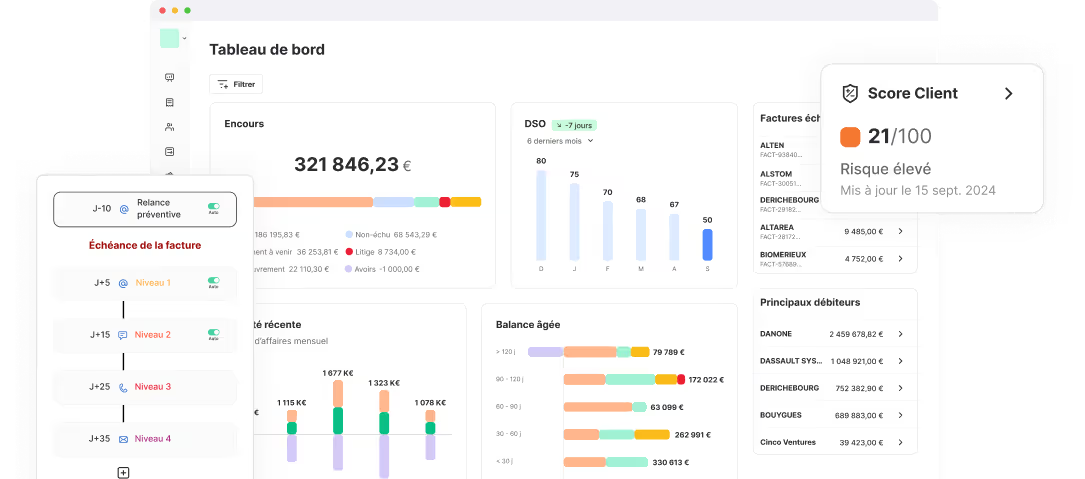
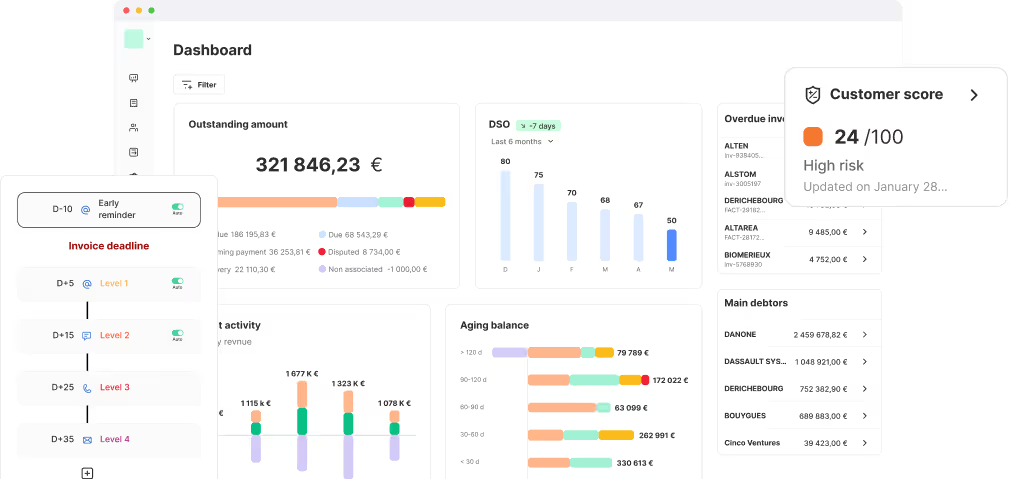
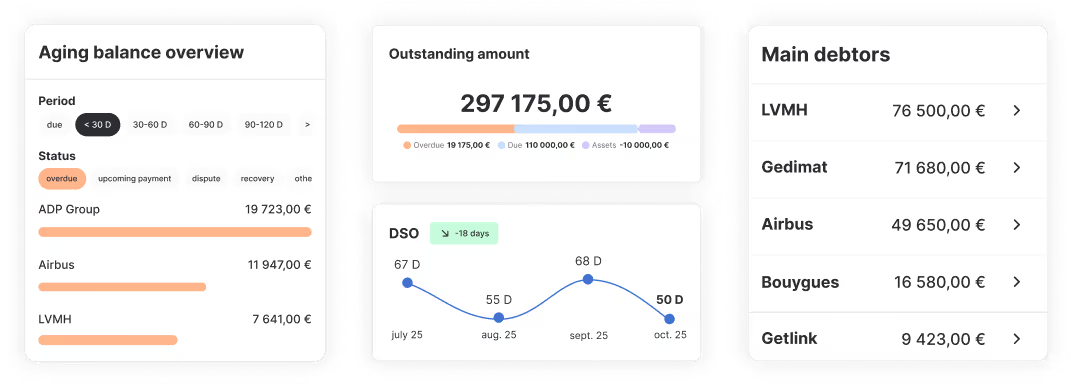
✅ Collections software: LeanPay dashboards are designed for cash management:
- global and customer-level DSO
- interactive aging balance
- impact tracking of reminders on payments
- performance analysis of workflows and team members
😊 Customer feedback: “The homepage gives a clear overview of our financial situation, showing paid, due and pending invoices, as well as payment delays.” Alan Thomas, Head of Accounting, Treasury and Collections, Serpe
.png)
Risk, disputes and legal escalation
⚠️ ERP reminder module: no customer risk management, no dispute handling, no litigation workflow.
✅ Collections software: LeanPay integrates all these key elements:
- financial scoring (Altares, Ellisphere, Creditsafe, Infolegale)
- alerts on insolvency proceedings
- credit insurance cover via Allianz Trade et Coface
- dispute tracking: categories, auto-exclusion of disputed invoices, workflows by dispute type
- litigation handling: auto-generated case file, sending to a partner, full tracking in LeanPay
😊 Customer feedback: “With LeanPay, we finally control accounts receivable with tangible results. We have had no unpaid invoices for a year.” Christian Tellier, CEO, Brillard et Choin
.png)
Financial impacts of collections based only on an ERP
Relying solely on ERP reminders carries real and costly consequences.
Impact on DSO: the ceiling of ERP reminder modules
In France, the average B2B payment delay in 2024 is 13,6 days.
LeanPay users see this decrease to 8,5 days on average over the last 12 months (September 2024 to August 2025).
An ERP module cannot achieve this level of performance. At best, expect a 15% decrease.
👉 Direct consequence: a more constrained working capital requirement. For example, 11,6 days of delay on 50 M€ corresponds to 1,59 M€ immobilised.
Higher customer risk
When an organisation relies only on its ERP module, it loses visibility on customer risk. Weak signals go unnoticed: slowly increasing delays, emails not opened, repeated broken promises to pay. External alerts (insolvency proceedings, deteriorating credit scores, incidents with other suppliers) are usually not integrated.
Risk also becomes concentrated on a few key accounts, with no formalised or monitored credit limits in place.
Disputes are another blind spot. Without workflow management, disputed invoices continue to be reminded automatically, damaging the customer relationship with no result. No preventive plan is applied to fragile customers: reminders start only after due date instead of anticipating.
Without coordination with credit insurance, companies also miss coverage opportunities or file claims too late.
The result: more unpaid invoices and higher write-offs.
Loss of productivity
ERP-based collections create heavy manual work. Information needed for follow-up is scattered across the ERP, CRM, email inboxes and document repositories. Before each reminder, the collector must reconstruct the full history.
There is often no clear context: previous reminders, promises kept or broken, credit notes, open disputes. This increases the risk of errors or of sending an inappropriate message that weakens the commercial relationship. Manual tracking of promises to pay is another weak point: without automatic reminders or conditional follow-ups, these promises are easily forgotten as soon as workload rises.
Coordination also becomes chaotic: who sends what, who calls, who handles disputes? Roles are unclear due to the absence of structured ownership. Prioritisation is also problematic and efforts become scattered. Even the analysis remains time-consuming because data must be exported, reprocessed and manually consolidated to obtain a global view.
This slows teams down and reduces performance.

Sustainable gains with a dedicated collection solution
Companies using LeanPay report quick and measurable results. DSO decreases by 40% in three months on average.
As Bruno Gainche, CFO of Thibaut, explains:
“Our group-wide target of a 40% DSO reduction was achieved thanks to structured follow-up and reminder processes via LeanPay. Very tangible impact on our cash flow.”
Productivity follows the same trend: time spent on reminders drops by 75% on average. It is even more significant at Pierres Investissement, as Nicolas Martel, Business Analyst, notes:
“The time needed to process and send reminders went from 10 days to 2. Time spent was divided by 5.”
Unpaid invoices stabilise below 1% thanks to risk prevention, robust dispute management and better-organised escalation.
These effects translate directly into cash. Reducing the average delay from 13,6 to 8,5 days generates nearly 700 000 € on 50 M€ turnover. And the benefits continue: faster dispute resolution, higher response rates thanks to multichannel reminders, improved customer relationships and better cash forecasting avec un suivi fiable des promesses de paiement.
Your ERP is essential for accounting. But to manage accounts receivable effectively, reduce payment delays and secure your cash flow, it must be complemented by dedicated collection software.
Book a personalised demo to discover all the LeanPay features that can turn collections into a real cash engine.
Obtenir le modèle :
Obtenir le modèle :