













Obtenir le modèle :
Résumer cet article avec :
As late payments increase, implementing an effective accounts receivable strategy has become a priority. But how can you be sure that your reminder workflows are actually delivering results?
Measuring the impact of reminders on cash collections is essential to identify the most effective levers, refine reminder scenarios and manage your actions with greater accuracy.
In this article, you will learn how to assess the performance of your payment reminders and how LeanPay helps you track these indicators clearly and automatically.
I find this debt collection software very functional, with excellent tracking of reminders and a clear, precise dashboard. Customer service is responsive.
Stéphanie H. - Collections Officer
Discover LeanPay 👉
The importance of structuring your accounts receivable strategy
Reducing late payments is not just about sending more reminders. It requires a clear, structured and measurable accounts receivable strategy, enabling teams to act methodically rather than relying on intuition.
A well-structured strategy offers several benefits:
- It standardises reminder actions and ensures consistent follow-up across teams.
- It helps prioritise efforts on invoices or customers presenting the highest risk.
- It enables performance tracking over time.
- It makes it easier to identify the most effective levers, such as the best-performing channels, the right timing for reminders or workflows that require adjustment.
- It shifts your organisation from a reactive approach to a proactive, data-driven model.
By structuring your accounts receivable strategy, you move from occasional follow-up to continuous performance management, based on data and outcome analysis.
How to assess the impact of your accounts receivable strategy
Measuring the impact of your accounts receivable strategy means understanding which actions genuinely contribute to cash collections. The goal is to identify the most effective reminder workflows, channels and escalation levels in order to refine your practices continuously.
Centralise reminder and payment data
Start by combining your two main data sources:
- Reminder actions carried out (date, channel, workflow, sender, level).
- Recorded payments (payment date, amount, payment method).
The objective is to link each payment to one or more reminder actions in order to measure their effectiveness.
LeanPay, our accounts receivable software, provides real-time data on your reminder workflows and automatically matches reminders with payments, helping you refine your analysis.
Define a clear observation period
To assess the real impact of reminders, analyse payments made within a defined timeframe after each reminder, for example 7, 15 or 30 days, depending on your reminder frequency and customer payment cycles. This approach isolates the direct effects of your actions, without bias from older or unrelated payments.
Track the right performance indicators
Several indicators help quantify the performance of your reminders.
- Post-reminder collection rate: This measures the proportion of cash collected following a reminder. A high rate indicates effective reminder workflows.
Amounts collected after reminders ÷ amounts reminded
Example:
In October, you sent reminders for 80 000 € in unpaid invoices and collected 50 000 € after reminders. Your post-reminder collection rate is 62,5 %, which is a solid level for a B2B organisation.
- Share of collections linked to reminders: This indicator assesses how much your cash flow depends on reminder actions.
Amounts collected after reminders ÷ total amounts collected over the period
Example:
Still in October, your company collected 120 000 € in total, including 50 000 € after reminders. This means 42 % of your customer collections depend directly on reminder actions carried out during the month, highlighting their key role in cash flow management.
Analyse results by segment
With LeanPay, you benefit from a comprehensive analytical view of reminder performance. You can measure the effectiveness of your accounts receivable strategy by refining the analysis according to the selected criteria.
The reminder impact chart shows, for each month and each reminder segment:
- Amounts reminded, collected and not reminded.
- The corresponding collection rate.
- A performance colour code to identify the most effective segments at a glance.
This visual approach helps you understand which reminder workflows generate the most payments and which require adjustment.
You can identify what works best:
- By reminder channel
Example: Are SMS reminders more effective than emails?
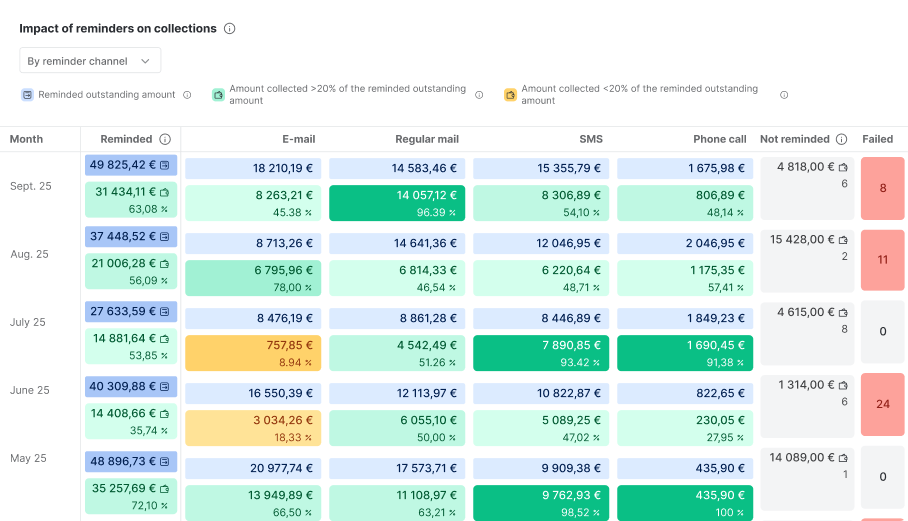
→ This chart shows that SMS and phone reminders performed particularly well in May and July 2025. Analysing the strategies implemented during those months would make it possible to replicate best practices and maintain similar collection rates in subsequent periods.
- By reminder level
Example: Do pre-due date reminders generate more collections than post-due reminders? If so, to what extent? Is the final reminder before legal recovery sufficient to prompt bad payers to settle their debt?
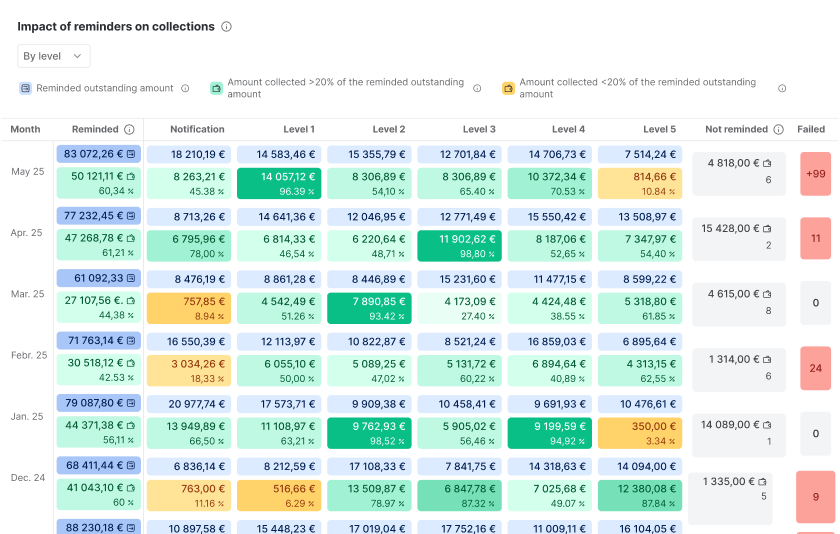
→ This visual highlights a clear improvement in the effectiveness of pre-due date reminders. While in December 2024 most payments were triggered from level 2 onwards, notifications account for nearly 80 % of collections in April 2025. This confirms that adjustments made to notifications are delivering tangible results.
- By number of days past due
Example: Is it better to shorten or extend the delay between the due date and the first reminder?
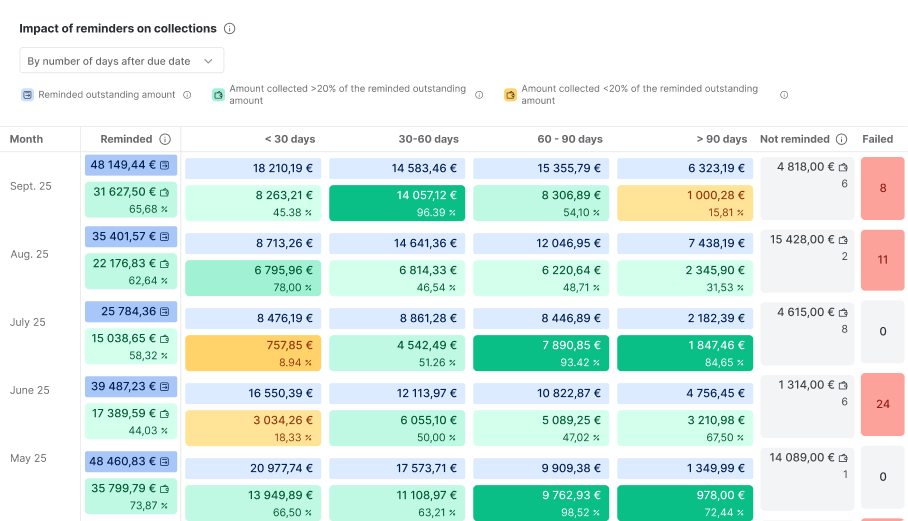
→ In August 2025, reminders sent within less than 30 days achieved the highest collection rates. However, performance shifted towards 30 to 60-day delays the following month, with higher rates. This change highlights a shift in collection dynamics and calls for further analysis of external factors, such as invoice volumes, seasonality or customer profiles, to fine-tune reminder management.
- By sender
Example: Are there performance gaps between collection team members?
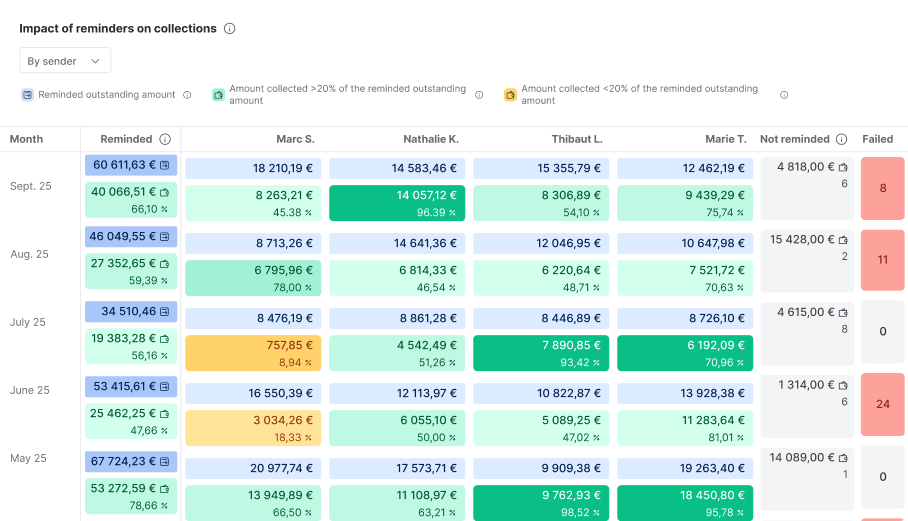
→ In September 2025, Nathalie K. achieved the highest collection rate, with 96,39 % of reminded amounts collected, while Marc S. saw performance drop to 45 %. These gaps underline the importance of tracking results by team member to identify best practices and improve consistency across reminders.
- By reminder workflow
Example: Is the workflow dedicated to key accounts more effective than the one designed for SMEs?
.png)
→ This analysis shows that the key accounts reminder workflow has become more effective over time, reaching 96,39 % of reminded amounts collected. By contrast, the performance of the other workflows remains inconsistent, with significant variations depending on the period.
By adopting this regular, analytical approach, you establish a genuine continuous improvement loop. Data informs decisions, and decisions strengthen reminder performance.
Tangible benefits for finance teams
- Time savings and visibility: performance data is calculated automatically and in real time.
- Data-driven decisions: each reminder workflow is adjusted based on actual results.
- Continuous improvement: best practices are scaled, late payments decrease and cash flow improves.
By centralising reminder data and cash collections, LeanPay turns accounts receivable tracking into true performance management. Your reminders become more targeted and more effective.
Discover how LeanPay helps you manage your accounts receivable strategy and improve cash collections by booking a demo with one of our experts.
FAQ: Accounts receivable strategy and reminder performance
1. What is an accounts receivable strategy?
An accounts receivable strategy defines how a company manages unpaid invoices, customer risk and payment follow-up. It combines reminder workflows, escalation rules, segmentation and performance monitoring to reduce late payments and protect cash flow in a structured, repeatable way.
2. Why is measuring the impact of reminders important?
Without measurement, reminders remain a tactical action rather than a performance lever. Measuring the impact of reminders helps identify which workflows, channels and timing actually contribute to cash collections, allowing finance teams to adjust their strategy based on results rather than assumptions.
3. Which KPIs should be tracked in an accounts receivable strategy?
Key indicators include the post-reminder collection rate, the share of collections linked to reminders, average days past due after reminder, and collection performance by segment. Tracking the same KPIs over time makes it possible to identify trends and measure the effectiveness of adjustments.
4. What is the best timeframe to measure reminder effectiveness?
A common best practice is to analyse payments received within 15 to 30 days after a reminder is sent. Beyond this window, payments are less likely to be directly linked to the reminder, which can distort performance analysis and lead to incorrect conclusions.
5. How can finance teams compare reminder performance across segments?
Reminder performance can be analysed by channel, reminder level, days past due, sender or reminder workflow. Segment-based analysis highlights which approaches generate the highest collection rates and which require adjustment, enabling more targeted and consistent follow-up.
6. How does software help optimise an accounts receivable strategy?
Accounts receivable software centralises reminder and payment data, automates KPI calculation and provides clear visual insights. This allows finance teams to move from manual tracking to continuous performance management, making reminder strategies more effective and easier to scale.
Obtenir le modèle :
Obtenir le modèle :