













Obtenir le modèle :
Résumer cet article avec :
In B2B environments, late payments are often associated with cash flow constraints on the customer side. Yet this explanation does not always tell the full story.
Some invoices are paid quickly, while others remain outstanding, not because of financial difficulties, but because of how they are perceived, prioritised and processed internally.
Prioritisation, communication clarity and the simplicity of the payment process all influence how invoices are handled. These factors ultimately shape different payment behaviours.
Understanding them allows businesses to approach collections differently by addressing the friction that slows payments rather than putting unnecessary strain on customer relationships.
I find this debt collection software very functional, with excellent tracking of reminders and a clear, precise dashboard. Customer service is responsive.
Stéphanie H. - Collections Officer
Discover LeanPay 👉
Payment behaviour: understanding late payments beyond cash flow
Even when customers have similar financial situations, they do not all prioritise payments in the same way.
Some invoices are processed immediately, while others move further down the list, despite the absence of disputes or financial difficulties. These differences are largely driven by payment behaviour.

This behaviour is shaped by several practical, often implicit, factors:
- Invoice visibility: an invoice that is difficult to locate or whose due date is not clearly highlighted is less likely to be prioritised.
- Supplier perception: suppliers viewed as strategic, reliable or well-organised are generally paid more quickly.
- Clarity of payment terms: clear deadlines, complete information and transparent payment instructions make it easier to approve and process payment.
Analysing payment behaviour goes beyond simply measuring late payments.
It involves observing how customers respond over time:
- how quickly they pay against due dates;
- how they react to payment reminders;
- how frequently delays occur;
- how consistent their payment habits are.
These signals help businesses understand not just whether a customer pays, but how they prioritise invoices within their organisation.
Payment behaviour is shaped by everyday interactions
Payment behaviour is not determined when an invoice becomes due.
It develops throughout the customer journey through daily interactions, operational habits and internal processes.
Every touchpoint linked to an invoice, from issuance and approval to follow-up and payment, influences where that invoice sits among the customer's priorities.
The clearer and smoother these interactions are, the easier it becomes for payment to fit naturally into the customer's internal workflows.
It is precisely these repeated interactions that create friction, or conversely, encourage more consistent payment habits.
Payment behaviour: three common sources of friction
Late payments rarely result from a single issue.
More often, they stem from multiple points of friction that accumulate throughout the payment process.
These obstacles may take different forms, but they share one common consequence: they slow down payment decisions, even when the customer has no intention of delaying payment.
Relationship-related friction
The relationship you maintain with your customer plays an important role in how invoices are treated and prioritised.
When communication is infrequent, impersonal or purely reactive, invoices often lose visibility and urgency.
An overly administrative tone, changing contacts or inconsistent follow-up can create the impression that payment is not genuinely important.
Organisational friction
Internal processes can also delay payment, regardless of customer goodwill.
Invoices may be delayed simply because they move slowly through approval workflows or become trapped in complex administrative processes.
Common obstacles include:
- lengthy or fragmented approval processes involving multiple stakeholders;
- missing or difficult-to-find information;
- documents and communications spread across multiple systems or channels.
These issues do not reflect an unwillingness to pay. Instead, they make it harder for invoices to fit into already demanding internal processes.
Psychological friction
Some sources of friction are linked to how payment itself is perceived.
An unclear due date, a complicated payment process or a lack of clear guidance can increase the effort customers associate with making a payment.
The more attention, verification steps and back-and-forth communication payment requires, the more likely it is to be postponed.
Payment behaviour: reducing friction throughout the payment process
Once the factors shaping payment behaviour have been identified, the next step is to address the elements that directly influence payment decisions.
Improve communication clarity
Communication plays a central role in how invoices are processed.
Clear expectations, consistent information and continuity throughout interactions make invoice management easier for customers.
Providing information in advance, sending reminders at the right time and maintaining consistent communication help reduce hesitation and minimise unfavourable payment decisions without damaging customer relationships.
Simplify the payment experience
The effort required to pay an invoice directly influences how that payment is prioritised.
The smoother the payment experience, the more naturally payment fits into the customer's daily operations.
Accessible invoices, consolidated information and fewer payment steps help remove friction throughout the customer payment journey.
Use payment behaviour analysis to guide your approach
Improving customer payment behaviour requires observing payment habits over time.
Recurring delays, payment trends and customer responses to follow-up communications all provide valuable insights.
By taking these signals into account, businesses can adapt their communication and follow-up strategies more effectively rather than relying on generic reminder workflows.
LeanPay: a smoother approach to B2B payments
These improvements can be implemented through dedicated tools such as LeanPay.
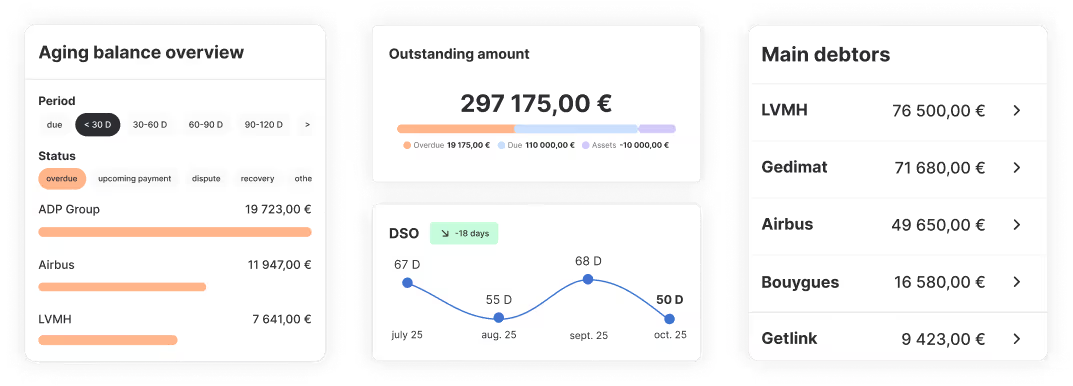
Our accounts receivable software helps businesses structure payment processes and reduce the friction that influences payment behaviour, without damaging customer relationships.
- You can create reminder workflows based on your customers' payment behaviour in order to maximise recovery rates.
- Automation rules automatically assign reminder workflows according to changes in customer behaviour.
.png)
- Through a secure link included in email and SMS reminders, customers gain access to a customer portal with an integrated payment platform. They can view invoice PDFs, communicate with your teams and pay securely by bank transfer, direct debit or card payment.
- Real-time credit scoring and recommended credit limits, powered by integrations with leading financial information providers and credit insurers (Altares, Creditsafe, Ellisphere, Allianz Trade, Coface…), help businesses identify customer risk earlier.
.png)
LeanPay helps businesses reduce friction, improve the payment experience and accelerate cash collection while maintaining strong customer relationships.
More than 3 000 finance teams already use LeanPay to gain greater control over accounts receivable.
Would you like to learn more about LeanPay? Get in touch with us.
Obtenir le modèle :
Obtenir le modèle :