













Obtenir le modèle :
Résumer cet article avec :
Artificial intelligence is gradually making its mark across customer-facing functions. Automated responses, conversational assistants, communication analysis and content generation: use cases are multiplying and finding their place in a growing number of businesses.
Debt collection is following the same trend. The arrival of artificial intelligence is opening up new possibilities and fuelling debate about the future of the customer relationship in collections.
This shift generates as much interest as it does questions. Customer relationships in collections occupy a particular place: every interaction can influence whether an invoice gets paid, but also the quality of the commercial relationship.
So how far can you genuinely hand over the customer relationship in collections to artificial intelligence?
I find this debt collection software very functional, with excellent tracking of reminders and a clear, precise dashboard. Customer service is responsive.
Stéphanie H. - Collections Officer
Discover LeanPay 👉
How does AI intervene in the customer relationship in collections?
The uses of artificial intelligence in collections are still relatively recent, but several applications already exist within the customer relationship.
Writing and personalising payment reminders
Writing payment reminders is one of the most widespread uses of AI. Working from the information available in a customer file, it can generate messages tailored to different contexts: a first reminder, a prolonged delay or a pre-due date follow-up.
Some solutions offer several formulations or tone levels suited to different reminder situations.
Analysing customer exchanges
The customer relationship in collections often generates a significant volume of information: payment promises, requests for extensions, disputes, supporting documents, contact details for multiple stakeholders. When this information is scattered, the risk of errors increases, such as sending a reminder to a contact who is no longer handling the account.
Artificial intelligence can help analyse these exchanges by identifying key elements and producing summaries that are actionable for your teams. It can also support case processing by surfacing the information most useful for decision-making.
Maintaining the customer relationship at scale
One of the main strengths of artificial intelligence lies in its ability to handle large volumes of interactions simultaneously.
In collections, this capability can help maintain regular follow-up with a large number of customers, without proportionally increasing the workload on your teams.
AI can, for example, be used to automate payment reminders or support exchanges through conversational or voice assistants.
These use cases make it possible to keep more frequent contact with customers while ensuring consistent case management.
AI and the customer relationship: why some situations still require human intervention
While artificial intelligence can take on tasks linked to the customer relationship, certain situations continue to require the judgement and involvement of your teams.

Not all decision-relevant information lives in your tools
AI can draw on the data available in your management systems, as well as the history of exchanges with your customers.
Some decisions, however, take into account elements that are not always captured in your tools: an ongoing commercial negotiation, a strategic consideration linked to a key account, or a specific instruction from senior management.
In these situations, human intervention is often necessary to factor in the full picture and guide the decision in the right direction.
Preserving a commercial relationship takes judgement
Collections is not simply about securing payment on an invoice. It also means maintaining a relationship of trust with customers.
Depending on how long a customer has been with you, their payment history or their importance to your business, your teams may need to adjust how they approach an interaction. They can also adapt as the situation evolves or as new information comes to light.
Some decisions directly commit the business
The choices made when following up on an unpaid invoice can have significant consequences, both for your business and for your customers.
This is the case when you need to agree to a payment plan, suspend a service or consider legal recovery proceedings, for example.
These decisions often involve weighing up competing objectives: securing payment, preserving the commercial relationship and limiting risk exposure.
How to use AI without losing control of the customer relationship
Deciding which interactions can be handed to AI
Not all customer interactions require the same level of involvement.
Some tasks, such as sending a first-level reminder or handling recurring requests, can more readily be automated.
Conversely, as noted above, situations involving a dispute, a negotiation or a risk of legal proceedings generally call for human intervention.
Before integrating artificial intelligence into your collections process, it is important to identify which actions you want to automate and which ones you prefer to keep under human control.
Feeding AI with reliable data
The effectiveness of artificial intelligence in collections depends largely on the quality of the information it can access. This requires having a clear, consolidated view of your accounts receivable.
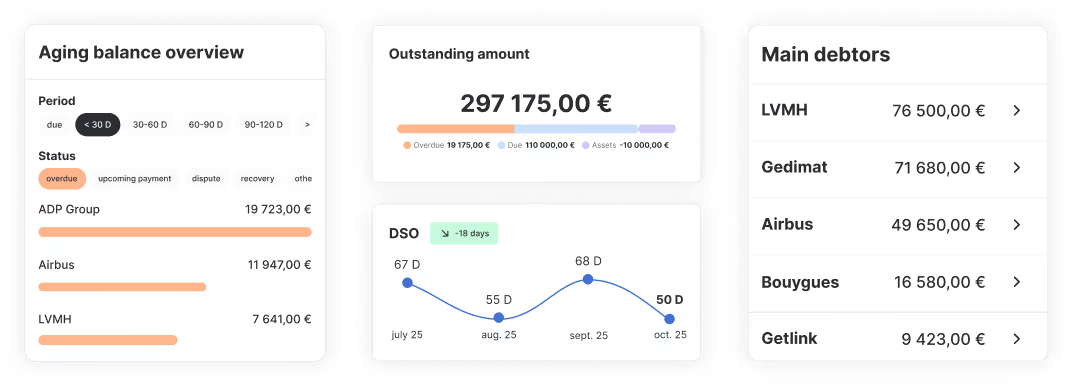
LeanPay centralises your customer data through integrations with your business tools (ERP, accounting software and more). You have everything in one place: invoices, recorded payments, key debtors and the full history of actions taken with each customer.
.png)
The platform also allows you to enrich this data with customer risk information, such as credit scoring from your financial information provider or coverage from your credit insurer.
.png)
This consolidated view provides a more reliable foundation for making the most of artificial intelligence and directing your collections efforts where they matter most.
Measuring the impact of actions taken
Having reliable data is a first step. But you also need to be able to measure how effective the actions taken on the basis of that data actually are. LeanPay's accounts receivable dashboard lets you track real-time indicators including:
- DSO;
- aging balance;
- outstanding amounts;
- cash collection forecast.
.png)
You can also analyse the impact of your payment reminders on collections performance, so you can refine your collections strategies and improve results over time.
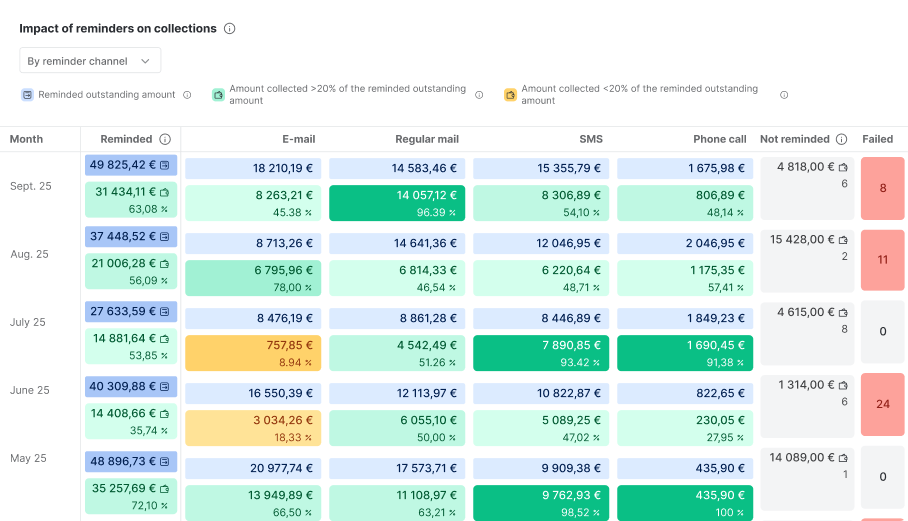
The more precisely your actions are measured, the more reliable a foundation artificial intelligence has to produce relevant analysis and help you improve your collections strategies.
Integrating artificial intelligence into collections is not about replacing your teams or automating the entire customer relationship. It is, above all, about finding the right balance between technology, reliable data and human expertise.
To discover how LeanPay can help you manage your accounts receivable and reduce your DSO by at least 40%, get in touch with us.
Obtenir le modèle :
Obtenir le modèle :