













Obtenir le modèle :
Résumer cet article avec :
A cash flow forecast outlines all expected inflows and outflows to help you anticipate liquidity needs and guide business decisions.
In practice, irregular customer payments are the main reason this balance breaks down. Late payments, unexpected issues or disputes can quickly undermine your financial stability.
Around one quarter of large companies and mid-sized businesses report a significant gap between their operational cash flow forecasts and actual cash positions. This is far from marginal. It highlights how fragile a cash flow forecast becomes when accounts receivable management is not fully under control.
Its monitoring should therefore be treated as a priority. So, which mistakes most often weaken a cash flow forecast, and how can you fix them? Let’s take a closer look.
5 common cash flow forecasting mistakes
A cash flow forecast is often weakened by the accumulation of small gaps. Payment delays, inaccurate data or incomplete tracking of your outstanding amount create discrepancies that make forecasts unreliable.
Here are the five most common causes of failure.
1. Late customer payments
Late payments directly distort your cash flow forecast.
If a customer pays 15 or 30 days late, this creates a temporary liquidity gap. Your business may then need to rely on short-term financing or delay supplier payments.
These repeated shifts desynchronise your cash inflows and outflows, making your cash forecast unreliable, even if your other assumptions, such as sales and fixed costs, are accurate.

A smart, evolving solution
Implemented in just a few weeks before summer 2023 with a fully operational Sage 100 connector. Our group's goal of reducing DSO by 40% was achieved in less than a year thanks to Leanpay!
Bruno G. - CFO
2. Invoices issued late or poorly tracked
A reliable cash flow forecast depends on accurate invoicing.
In many companies:
- invoices are sent late
- data is incomplete
- some invoices are simply forgotten
This creates discrepancies between your forecast and actual cash flow.
Conversely, duplicated invoices or cancellations that are not updated can artificially inflate expected inflows.
These issues may seem minor, but they significantly reduce visibility. Your business may expect cash that will never actually be collected.
3. Lack of visibility on outstanding amounts and cash inflows
Your cash flow forecasting becomes approximate if your outstanding amount is not tracked accurately.
Many finance teams rely on incomplete Excel files that do not reflect real-time payment status.
If you do not know which invoices are paid, overdue or disputed, you cannot anticipate cash movements correctly.
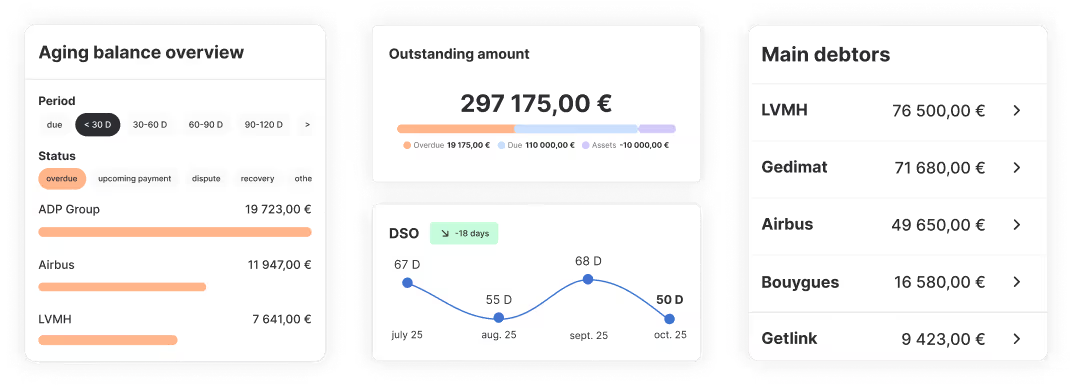
Often overlooked, the aging balance provides an immediate and structured view. It allows you to classify invoices by age and identify truly at-risk amounts.
Without it, your cash forecast relies on overly generic assumptions and loses operational value.
4. Lack of automation
Without automation, your cash flow forecasting quickly becomes outdated and unreliable.
Companies that manually record payments and update forecasts are exposed to:
- missed updates
- timing discrepancies
- human error
As invoice volumes grow, while team size remains limited, these risks multiply.
Beyond time loss, the lack of automation prevents daily updates. Decisions are then based on outdated figures that no longer reflect reality.
5. Unanticipated disputes and unpaid invoices
Disputes and unpaid invoices heavily impact the reliability of your cash flow forecast.
A dispute can delay payment by several weeks. An unpaid invoice cancels expected cash inflows entirely.
Without tools to identify risky customers or track disputes, these events will continue to undermine your forecasts.
According to the Allianz Trade 2025 Customer Risk Barometer, 62,6% of companies experienced unpaid invoices, an increase of 11,6% compared with 2023, and 58,8% faced a customer default.
These risks are still too often underestimated in cash flow forecasting.
The consequences of an inaccurate cash flow forecast
A cash flow forecast loses its value if it does not reflect actual inflows.
This leads to immediate and sometimes costly consequences for your business.
Bank overdrafts and fees
An inaccurate forecast can create unexpected liquidity shortages.
Your company may fall into overdraft even though your forecast showed a positive balance.
You may then need to rely on short-term financing, generating additional bank charges.
These bank charges, linked to overdrafts and debit interest, erode your margin and weaken your profitability. The more unpredictable your cash flow, the more frequent and difficult these charges become.

Financing difficulties
Poor forecasting also affects relationships with financial partners.
Banks rely on the quality of your projections to assess your ability to meet obligations.
Large discrepancies reduce your credibility and can lead to:
- restricted access to financing
- less favourable conditions (interest rates, guarantees)
- difficulty securing new funding
This can ultimately slow down your growth.
Stress for finance teams and time loss
Unstable cash flow increases pressure on finance teams.
Instead of focusing on optimisation and planning, finance leaders spend time managing urgent issues:
- renegotiating deadlines
- contacting banks
- constantly adjusting forecasts
This reactive approach creates stress and reduces efficiency.
How to improve your cash flow forecast through accounts receivable
Your cash flow forecast becomes reliable only when your accounts receivable is properly managed.
When reminders are structured, financial data is up to date and communication is smooth, unpaid invoice risks are better anticipated.
Structure payment reminders and customer follow-up
The quality of your cash flow forecasting depends on how your reminders are organised.
Not all customers behave the same:
- some pay on time
- others regularly delay payments
A single approach for all customers is rarely effective.
The best approach is to create tailored reminder workflows based on:
- customer behaviour
- risk level
A high-risk customer requires strict follow-up, while a reliable customer can be managed more flexibly.
LeanPay, our accounts receivable software, simplifies this by automatically synchronising invoices, amounts, due dates and payments from your ERP or accounting software. → See all of our integrations.
Your teams start each day with a clear task list prioritising actions. This reduces missed follow-ups and improves forecast accuracy.
Automate reporting
Automation transforms your cash flow forecast into a true decision-making tool.
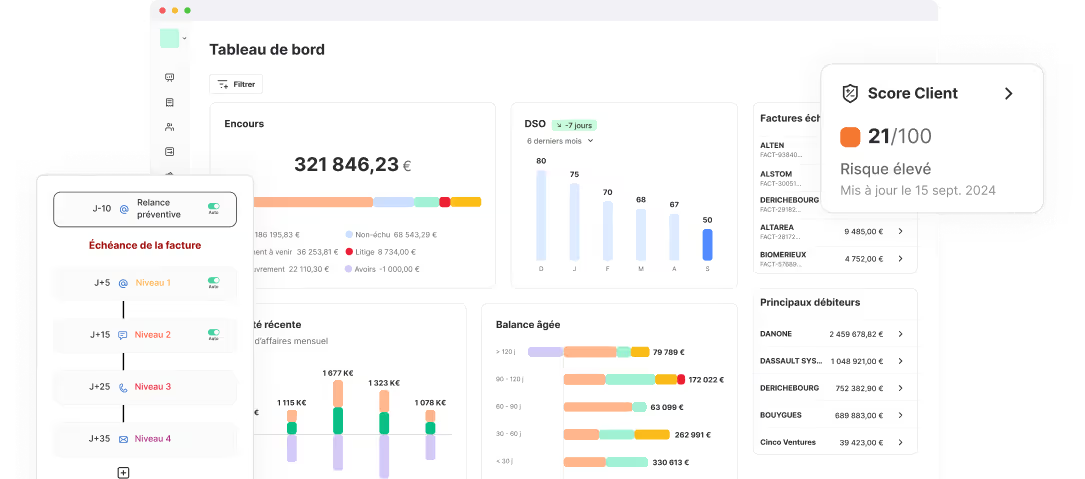
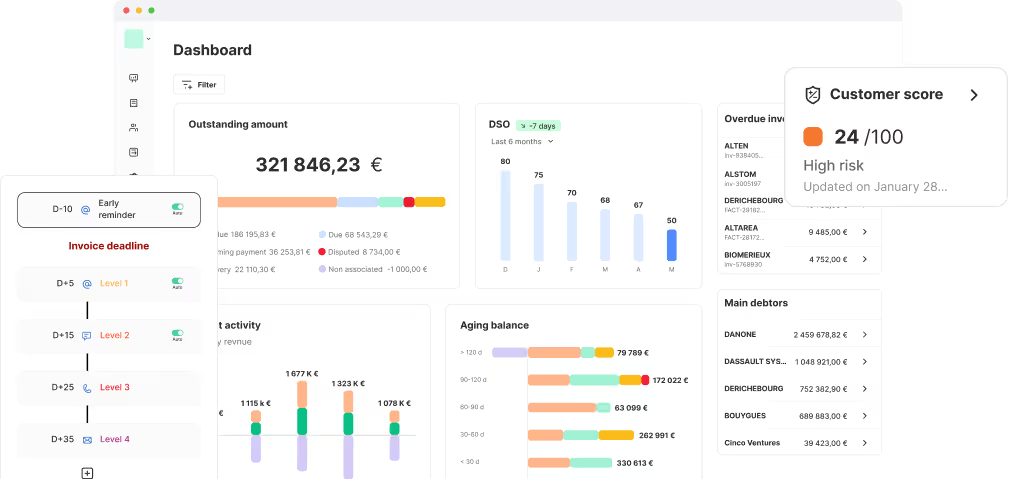
In our accounts receivable dashboard, key indicators such as DSO or aging balance are updated continuously.
LeanPay enhances your cash forecast by analysing payment behaviour over the last three months, rather than relying solely on due dates.
This realistic approach prevents misleading projections and aligns forecasts with actual cash flow.
Improve communication with customers
Cash collection reliability also depends on communication quality.
Every missing invoice, duplicate request or misunderstanding delays payment.
LeanPay provides a customer portal where they can:
- access their invoices
- pay online (card, transfer or direct debit)
- request payment plans
- report disputes
These features reduce friction and accelerate payments, making your inflows more predictable.
Anticipate unpaid invoice risks
A reliable cash flow forecast must include the probability of default.
This requires analysing each customer’s:
- financial strength
- payment history
LeanPay as a credit risk management software centralises data from providers such as Altares, Creditsafe, Ellisphere, Infolegale, Coface and Allianz Trade.
You gain access to:
- credit scoring
- payment history
- recommended credit limits
- insured amounts
Configurable alerts help detect critical outstanding amounts immediately.
This transforms your cash flow forecast into a proactive tool. Instead of reacting to delays, you can adjust payment terms or act earlier.
A cash flow forecast becomes reliable when customer tracking is structured and information flows seamlessly.
Your teams can rely on up-to-date data and better anticipate risks.
LeanPay makes the entire process clearer:
- structured reminders
- indicators based on real payment behaviour
- alerts for unpaid invoice risk
Let’s improve the reliability of your accounts receivable together 👇
Obtenir le modèle :
Obtenir le modèle :